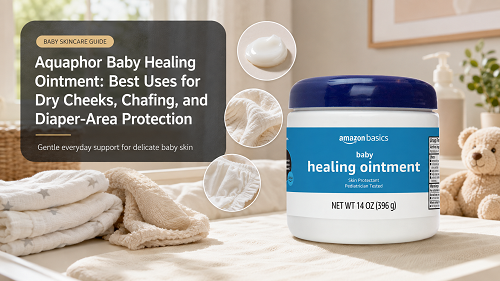
Aquaphor Baby Healing Ointment is the product at the center of this guide. Aquaphor Baby Healing Ointment is a petrolatum-based skin protectant. The current product page lists 41% petrolatum and highlights panthenol and glycerin in a preservative- and fragrance-free ointment designed for dry, chapped, or irritated skin. The goal is not to label one formula as perfect for every baby, but to help parents compare ingredients, texture, routine fit, and signs that a product should be stopped.
It is most useful when parents need an occlusive layer over dry cheeks, chafed areas, or skin exposed to repeated wetness. Because the texture is thick, a very small amount can cover a focused area. Start with a small amount, keep the rest of the routine stable, and judge the baby’s skin over repeated use rather than one application.
Aquaphor Baby Healing Ointment: What The Formula Contributes
Petrolatum reduces water loss by forming a physical barrier. That makes it different from a lightweight lotion, which adds water and emollients but usually forms a less persistent occlusive layer.
The official page confirms the current 41% petrolatum active ingredient and directions for this petrolatum baby skin protectant.
Texture, Ingredients, And Sensitive-Skin Trade-Offs
For dry cheeks, apply a thin film to clean skin and keep the product away from the eyes and mouth. Reapply when the barrier has rubbed off rather than creating a very thick layer that transfers everywhere.
The internal product listing is useful when you are comparing an ointment for chafed baby skin by package size and current availability.
In the diaper area, ointment can help protect from wetness and friction. The more important foundation is still prompt diaper changes, gentle cleaning, and allowing the skin to dry before applying the barrier.
For dry cheek barrier care, a thin occlusive layer can be paired with a broader moisturizing routine when cheeks become rough from wind, drool, or dry air.
Fit The Product Into A Minimal Moisture Routine
Use moisturizer on clean skin and focus first on the areas that actually feel dry. After a bath, gently pat the skin and apply the product before the skin has become completely dry. Avoid layering several new lotions, oils, and ointments together because that makes tolerance difficult to interpret.
A diaper-area moisture shield works best after the diaper area has been gently cleaned and allowed to dry, not as a substitute for prompt diaper changes.
Match texture to the job. Lotion is efficient over large areas, cream provides more richness, and ointment forms a stronger occlusive layer over focused dry or chafed areas. The best routine is the simplest one that keeps the skin comfortable.
For cracked skin protection for babies, stop self-treating if cracks are deep, bleeding, painful, or surrounded by spreading redness.
What Parents Should Compare Before Buying
Read the current package instead of relying on an old marketplace description. Formulas, fragrance choices, active ingredients, age directions, and warnings can change. Compare the complete label with the job you want the product to do.
| Decision Point | Current Position | Why It Matters |
|---|---|---|
| Active ingredient | Petrolatum 41% | Occlusive skin protectant |
| Texture | Thick ointment | Best for focused barrier use |
| Fragrance/preservatives | Free of both per current page | Simple option for sensitive routines |
| Typical role | Dry/chapped skin and barrier protection | Not a treatment for infection |
An occlusive baby moisturizer guide helps explain why ointments stay on the skin longer than lotions and why a small amount is often enough for focused areas.
For Aquaphor Baby Healing Ointment, the most useful question is whether the formula solves a real routine problem without adding unnecessary steps. A product that is easy to apply, easy to stop, and easy to evaluate is often more practical than a complicated routine built around marketing claims.
A Practical First-Use Checklist
- Confirm the exact product, variant, age guidance, ingredient list, and warnings on the package.
- Introduce Aquaphor Baby Healing Ointment without adding another new skincare product on the same day.
- Use a small amount on a limited area first when the child has sensitive or reactive skin.
- Follow the label for rinse-off versus leave-on use and keep products away from the eyes and mouth unless specifically intended there.
- Check the skin again later the same day and over the next several uses for redness, dryness, swelling, or discomfort.
- Stop and seek professional guidance when symptoms are severe, persistent, infected-looking, or associated with a baby who seems unwell.
Write down the date the product was started and keep the bottle or package until you know it is tolerated. This simple habit makes it easier to identify the likely trigger if several caregivers share the routine.
How To Decide If Aquaphor Baby Healing Ointment Fits Your Routine
Choose Aquaphor when you need a fragrance-free petrolatum barrier for focused dry or chafed areas. Use lotion or cream for broader everyday hydration when the skin does not need such a heavy occlusive finish.
Use the product according to its current label, observe the skin rather than the marketing, and keep the surrounding routine simple. That approach gives parents a clearer answer about whether Aquaphor Baby Healing Ointment is comfortable and useful for their own baby.
Frequently Asked Questions
What percentage of petrolatum is in Aquaphor Baby Healing Ointment?
The current product page lists petrolatum 41% as the active ingredient.
Can I use it on dry baby cheeks?
The brand lists dry and chapped baby skin among its uses. Apply a thin layer to clean skin and keep it away from the eyes and mouth.
Is Aquaphor a moisturizer or a barrier?
It is primarily an occlusive skin protectant. It helps reduce water loss and can be layered over skin that has already been moisturized.
Can it be used in the diaper area?
The product is used as a barrier for diaper-area irritation, but prompt changes and gentle cleaning remain essential.
When should I stop home care and seek medical advice?
Seek care for spreading redness, blisters, pus, fever, significant pain, or a rash that is not improving as expected.
