
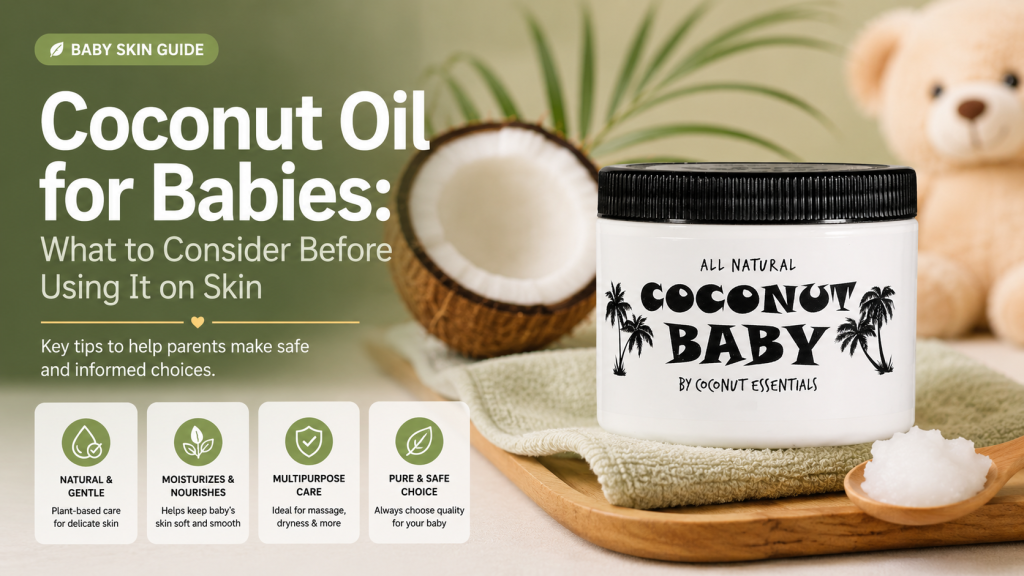
Coconut oil for babies is popular because it is simple, easy to spread, and commonly available, but “natural” does not mean suitable for every child or every rash. Coconut is a food ingredient, the oil can vary in refinement and scent, and some babies may develop irritation or allergy.
Use only a product with clear skin-use directions and intact packaging. Do not apply it to broken, infected, or weeping skin, and do not use it as a substitute for medical treatment. Parents should be especially cautious when the baby has eczema, known food allergy, or a strong family allergy history.
Is Coconut Oil For Babies A Good Match For The Skin?
Coconut oil is primarily an emollient and occlusive oil. It can reduce friction and leave a protective film, but it does not add water to the skin. Very dry skin may need a water-based moisturizer or clinician-recommended routine instead of oil alone.
The intended body area matters. An oil that works on a small dry leg patch may be too heavy for warm folds, the scalp, or the face. Avoid the eye and mouth area and keep oily hands away from pacifiers, bottle nipples, and surfaces that become slippery.
Coconut Oil Qualities Parents Should Compare
Product labels should make the source, processing, ingredients, storage, and intended use easy to understand.
Refined And Unrefined Options
Unrefined oil often has a stronger coconut aroma and retains more naturally occurring components. Refined oil may have a milder smell, but processing methods and quality vary.
Neither type is automatically safer. Choose a reputable, clearly labelled product and consider scent sensitivity and food allergy history.
Purity And Added Ingredients
Some baby oils contain coconut as one ingredient among fragrance, essential oils, and other botanicals. A single-ingredient label is easier to assess, but it can still cause a reaction.
Read the complete label and avoid assuming that organic certification predicts individual tolerance.
Melting And Texture
Coconut oil changes between solid and liquid depending on room temperature. This is normal, but repeated heat exposure or contamination can affect quality.
Use a clean utensil or pump, warm only a tiny amount between hands, and never microwave a container before applying it to a baby.
Food Allergy Context
Skin exposure to food-derived ingredients is a concern parents should discuss with a clinician when the baby has eczema, food allergy, or a strong allergy history.
Do not use a skin product to test whether a baby can eat coconut. Feeding decisions require age-appropriate medical guidance.
Storage And Oxidation
Oil should have a normal appearance and smell for the product. Heat, light, water, and dirty fingers can shorten its useful life.
Keep the container closed and dry, and discard it if the smell, colour, or texture changes unexpectedly.
Review Coconut Oil In The Context Of The Whole Routine
An organic coconut baby oil should still provide clear skin-use directions, ingredients, storage guidance, and an intact seal.
A broader guide to baby skin moisture helps explain why an oil film and a water-based moisturizer can play different roles.
A cold-pressed coconut oil claim describes processing but does not guarantee that the oil will suit a baby with sensitive or allergy-prone skin.
An infant massage oil may combine coconut with other oils, so every ingredient should be reviewed rather than focusing on the first one.
FDA information about cosmetic allergens supports careful patch testing baby oil and stopping a product when a reaction appears.
A natural baby emollient can be useful, but natural positioning should be weighed alongside preservation, packaging, directions, and allergy considerations.
Coconut Oil Buying Questions
Ask these questions before applying the oil rather than relying on a single purity or organic claim.
| Question | Why It Matters | What To Verify |
|---|---|---|
| Is it intended for skin? | Food products may lack infant skin directions | Age, body area, and warnings |
| What else is added? | Fragrance and botanicals add exposure | Complete ingredient list |
| How is it dispensed? | Open jars are easier to contaminate | Clean pump, tube, or utensil |
| How is it stored? | Heat and water can change oil quality | Expiry and storage directions |
| Is allergy history relevant? | Food-derived ingredients may require caution | Pediatric or allergy advice |
Use A Small Amount And Observe
A gradual introduction reduces unnecessary exposure and makes a reaction easier to connect with the correct product.
- Confirm the oil is intended for the baby’s age and skin area.
- Check the seal, date, smell, and complete ingredient list.
- Apply a tiny amount to a small area of healthy skin.
- Observe for redness, bumps, swelling, itching, or discomfort.
- If tolerated, use a thin film on the intended area without vigorous rubbing.
- Keep oily hands away from eyes, mouth, feeding items, and slippery surfaces.
Do not layer coconut oil over a new lotion or cream during the first trial. Testing one product at a time gives clearer information.
Use Coconut Oil As A Simple Product, Not A Cure
Coconut oil for babies may provide slip and a light occlusive layer when the product is clearly labelled, stored correctly, and tolerated. It is not automatically hypoallergenic, and it does not treat eczema, infection, or every type of dryness.
Patch test, use a small amount, and keep the routine simple. When skin remains inflamed or uncomfortable, professional assessment is more useful than changing from one natural oil to another.
Frequently Asked Questions
Is coconut oil safe for newborn skin?
Suitability depends on age guidance, skin condition, and allergy history. Ask a pediatrician before use on newborns with rash, eczema, or medical complexity.
Can coconut oil replace baby lotion?
Not always. Oil reduces water loss but does not provide the same water-based hydration as a lotion or cream.
Should I use refined or virgin coconut oil?
Neither is universally better. Compare intended use, scent, processing information, packaging, and the baby’s tolerance.
Can coconut oil be used for cradle cap?
Ask a healthcare professional and follow cradle-cap guidance. Oil can loosen scale but may be difficult to remove and is not suitable for every scalp condition.
What should I do if a rash appears?
Stop the product, gently follow label removal directions, and seek medical advice if the reaction persists, spreads, or includes swelling or breathing symptoms.
